case study
We Reviewed an AI Startup’s Website with Preveo. Here’s What Its Founder Said.
How three Preveo evaluations of Baani AI’s website covered UX copy, cross-device performance, and SEO—and what its founder said when we shared the reports.

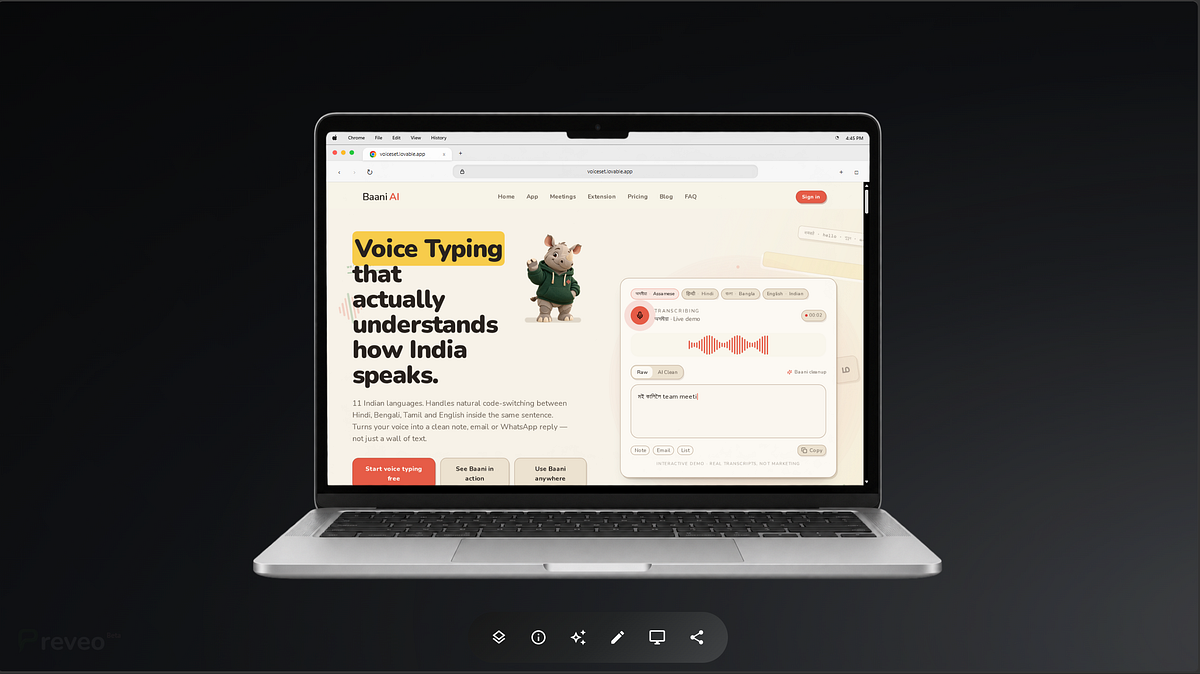
A real-world case study of how three AI-powered website evaluations helped start a conversation about better UX, performance, and Google visibility.
Building an AI product is hard. Getting people to discover it, understand its value, and sign up can be even harder.
A founder can spend months building something genuinely useful, only to lose potential customers because the landing page doesn’t explain the product clearly, performs inconsistently across devices, or isn’t structured effectively for search engines.
That’s exactly the kind of problem we’re trying to solve with Preveo.
Recently, we discovered Baani AI, an AI product focused on Indian-language voice typing and meeting summaries.
Instead of simply reaching out to its creator and asking him to try Preveo, we decided to do something different.
We evaluated the website first, generated three reports, and shared the results with the founder.
His response made the experiment worthwhile.
The Product: Baani AI
Baani AI addresses an important problem: making voice-based productivity tools more useful for people who speak Indian languages.
The product supports workflows such as converting spoken language into editable text and producing meeting summaries and action items.
It’s a compelling idea, particularly for users who naturally switch between Indian languages and English.
But even a promising product faces three important questions when someone lands on its website:
- Can visitors immediately understand what the product does and why they should try it?
- Does the website deliver a good experience on different devices?
- Can search engines understand the content and connect it with relevant searches?
We wanted to see how Preveo could help answer these questions.
Three Evaluations, Three Opportunities to Improve
We ran three different Preveo evaluations, each approaching the website from a different perspective.
1. Is the Website Communicating Its Value?
The first evaluation focused on the landing page’s written content.
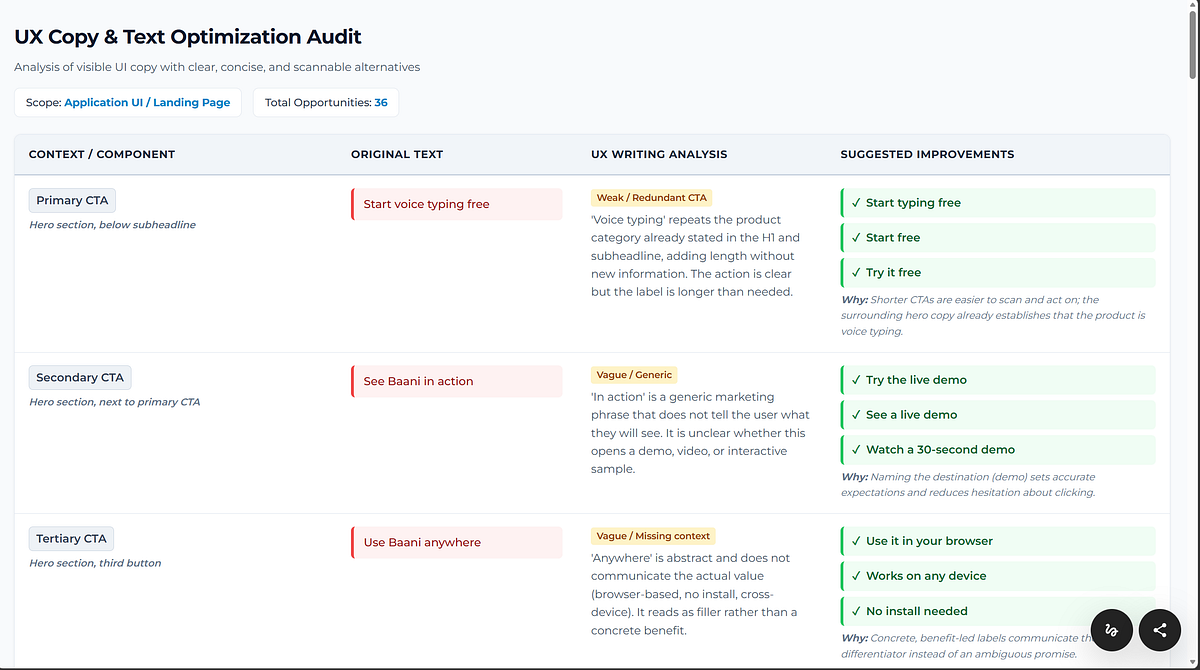
When someone discovers an unfamiliar AI product, they often decide within seconds whether to continue exploring.
The headline, supporting text, feature descriptions, and calls to action all influence that decision.
A website can explain what a product technically does without clearly communicating why someone needs it.
Using Preveo’s UX Copy & Text Optimization Audit, we evaluated the landing page’s messaging and identified opportunities to make its content clearer, more persuasive, and better aligned with visitor expectations.
The evaluation focused on questions such as:
- Does the headline communicate a meaningful benefit?
- Are the product’s capabilities explained in language potential customers can understand?
- Is there a clear reason to sign up or try the product?
- Could any wording create confusion or hesitation?
This matters because bringing more visitors to a website is only part of the challenge. Visitors also need to understand what makes the product worth trying.
Preveo turns this kind of evaluation into a visual report that can be shared with the team and used to guide copy improvements.
Explore Baani AI’s UX Copy & Text Optimization Report
2. Performance: Does the Website Work Well Across Devices?
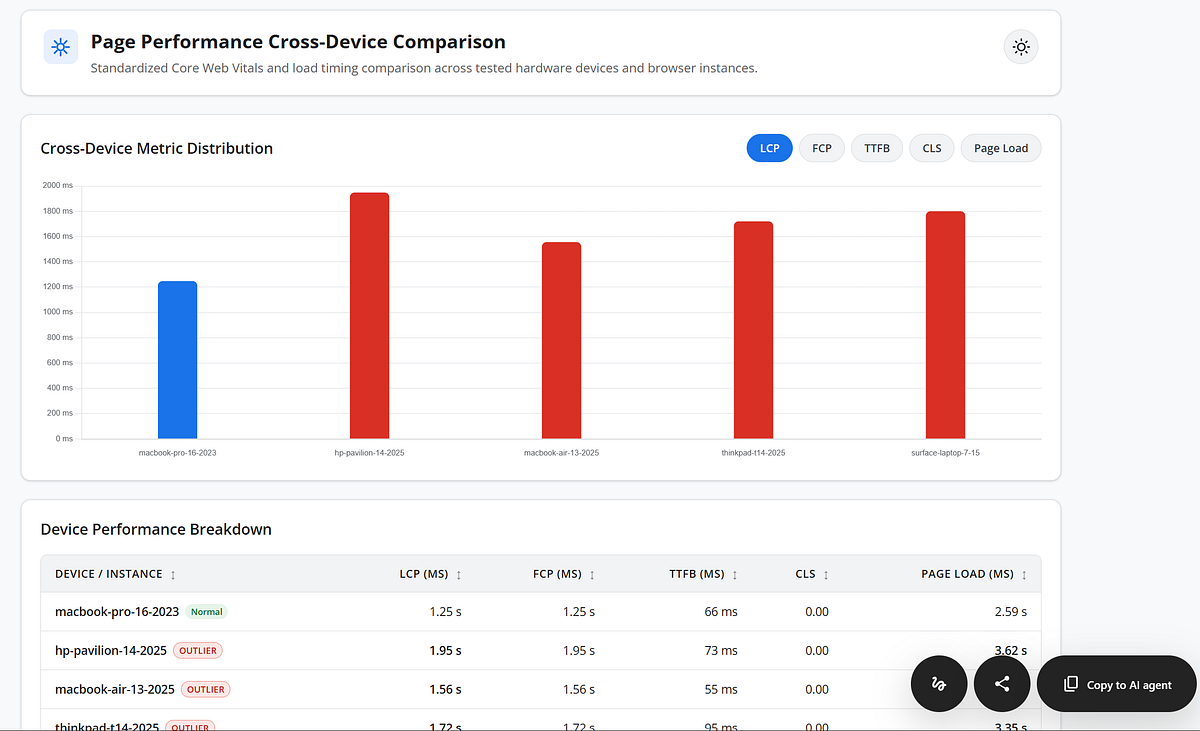
Website performance across five devices.
For a product trying to attract new users, speed is part of the first impression.
A website that loads quickly on one laptop might behave differently on another.
The comparison shown here covers five laptop configurations. Mobile testing is a useful follow-up, especially when potential customers discover products through their phones.
We used Preveo’s Page Performance Cross-Device Comparison to examine the landing page under different device conditions.
Rather than treating performance as a single number, this kind of evaluation helps teams compare the experience across devices and understand where investigation is needed.
The report is designed to make performance differences more visible and easier to discuss.
This is especially important for small teams, where developers need to decide which improvements deserve attention first.
Performance also contributes to page experience, although improving performance alone doesn’t guarantee better Google rankings.
Explore Baani AI’s Cross-Device Performance Report
3. SEO: Can Google Understand the Website?
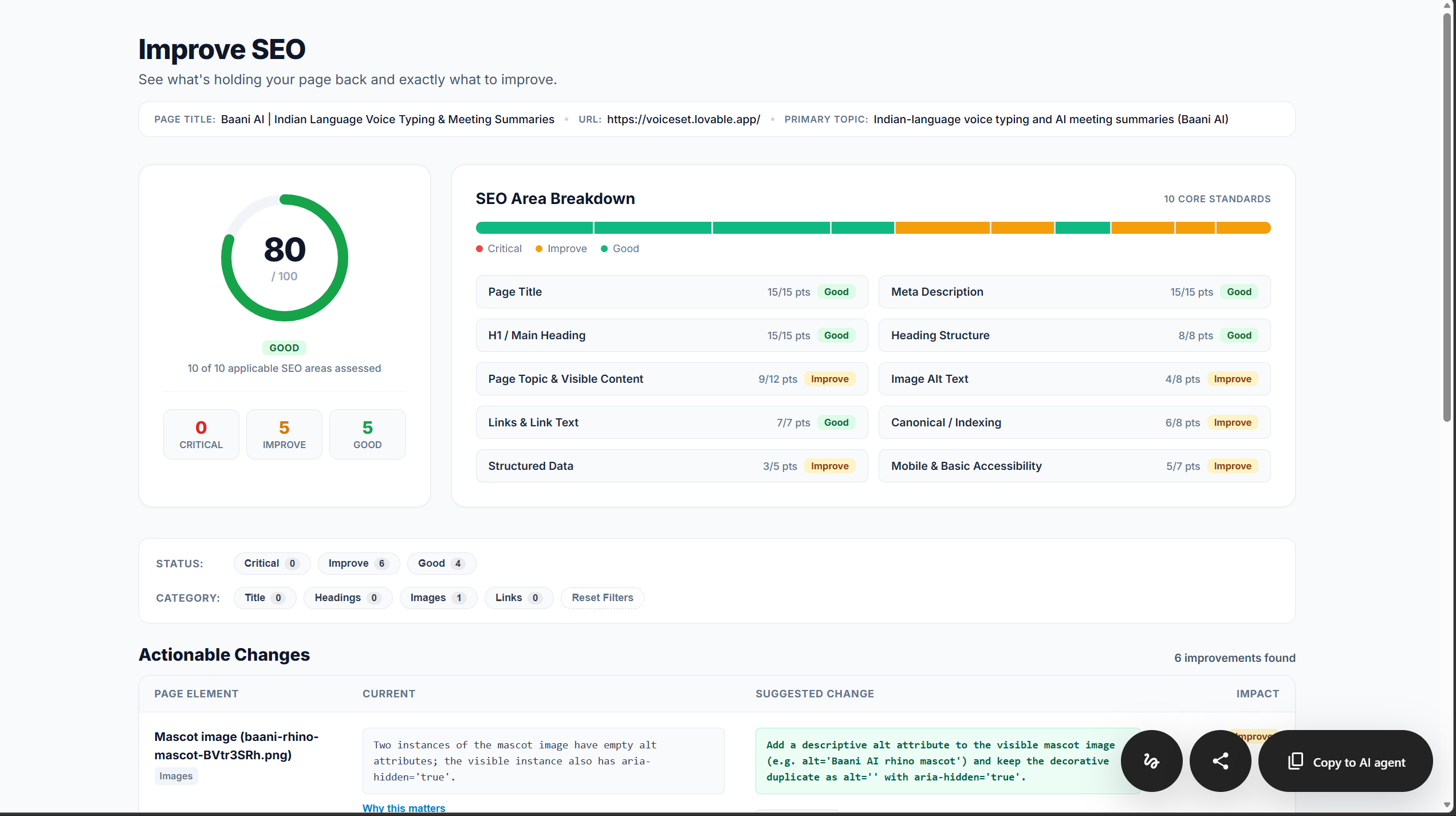
Baani AI’s on-page SEO evaluation.
A good product doesn’t automatically become a discoverable product.
Search engines need accessible, meaningful content to understand what a website offers and when it might be relevant to a search.
For Baani AI, potential search topics include Indian-language voice typing, transcription, and AI meeting summaries.
We used Preveo’s SEO Improvement Report to examine the landing page’s on-page search optimization.
The evaluation focused on areas such as page metadata, heading structure, content clarity, and other signals that help search engines interpret the page.
The objective wasn’t to promise a higher position on Google.
It was to identify improvements that could make the page easier to understand, better structured, and more relevant to potential visitors.
For early-stage founders, that distinction matters.
You can’t force Google to rank a page. But you can improve the information and structure that Google uses to evaluate it.
Explore Baani AI’s SEO Improvement Report
What Happened When We Shared the Reports?
After completing the evaluations, we contacted Rajveer, the creator of Baani AI.
We opened by acknowledging the potential we saw in his product.
Then, instead of sending a generic product pitch, we shared the three reports and explained why we thought each one was relevant.
We talked about making the landing page more persuasive, investigating cross-device performance, and improving its structure for Google Search.
We also included a link to Preveo’s wider collection of evaluation tools, such as its AI recommendation-readiness checks.
The entire outreach was centered on his website, not on promoting ours.
And Rajveer responded:
"Nice to see the Reports about Baani Ai, My team is already working on these problems. I loved your product."
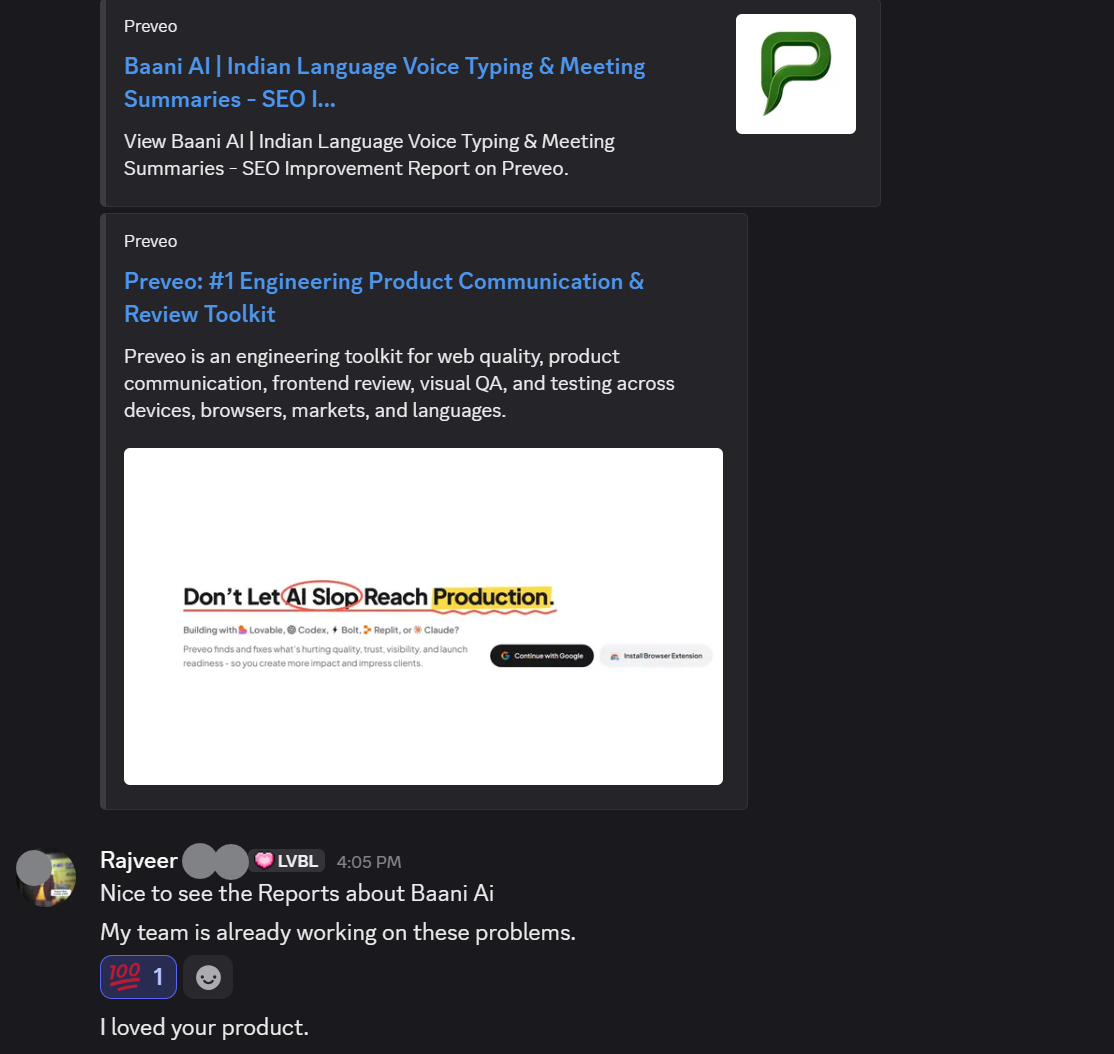
That response was particularly encouraging for two reasons.
First, he recognized the problems as relevant enough that his team was already working on them.
Second, he explicitly expressed appreciation for Preveo.io.
We didn’t need to convince him that website quality mattered. The reports connected with issues his team already understood.
The Bigger Lesson
Founders building with AI tools can create and launch applications faster than ever.
But generating a working website doesn’t automatically make that website effective.
You still need to know whether people understand it, whether it performs well across devices, whether search engines can interpret it, and whether it creates enough confidence for someone to take action.
That’s why we built Preveo.
Not simply to tell someone their website has problems, but to help them see what needs attention, understand why it matters, and get guidance on how to improve it.
Want to see what Preveo finds on your own website?
Explore the Preveo Macro Library and run an evaluation on your website.
Disclosure: This case study is written by the team behind Preveo. Rajveer’s response is quoted from a direct exchange. Baani AI is featured as an independently evaluated product; this article does not imply a paid partnership, formal endorsement, or confirmed implementation of the recommendations.
 Install Browser Extension